
Supplements Ready, and Cairo Update
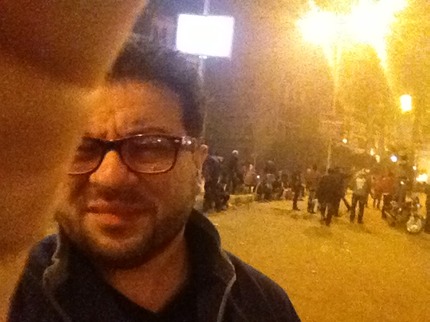
hi everyone from bloody cairo, where i just returned from one of the most violent sites of clashes between the opposition and the President's supporters (more on this soon)
Your course supplements are now up under the "Readings" page. Given you have the questions already, all you have to do is practice all the answers, and brush up on the core articles. I will send you the take home portion on Sunday, at the latest.
I hope you enjoyed our guest speakers. I heard good reports about that.
Please let me knwo if you have any questions. The final exam should be a piece of cake! Stay out of trouble and don't do anything i wouldn't do.
bassam
Here you can see the photo essay i produced last night from Tahris Square, when clashes were moderate by comparison. Wait till you see the video from tonight. Hollywood style, molotov bombs, tear gas, live bullets, and big stones thrown everywhere.
(first image) Site of the Roxy Square clashes. 5 people dead, 300+ injured. I have all of it on video, to be posted shortly on Jadaliyya. This shit is for real! It's all over the news everywhere (if mom knows i voluntarily headed to the eye of the storm, she'll have a heart-attach in Fairfax VA.
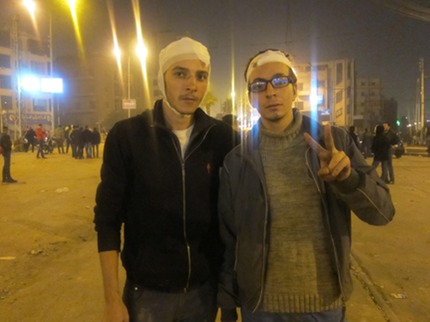
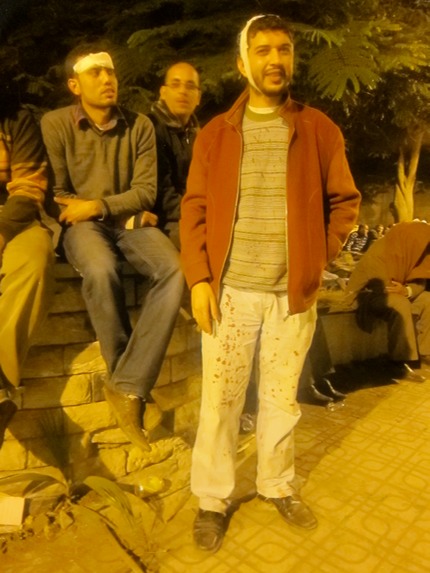
(second and third images) Bloodied opponents of President Morsi followed by bloodied supporters.
Final Exam, and Tuesday
hi everyone,
for Tuesday, you only have to read the conclusion in your textbook (C11 reading below). Instead of holding a review session outside class time, we will be holding the review session in class this Tuesday. I'll give you the exam study sheet then too.
you will have one more class after next week, on December 4th, to which you will also be responsible for the Exam as there will be questions based on the guest lectures then.
so, do not miss any of the next two weeks if you would like to do well on the final.
see you soon.
bassam
(c11) Future Prospects
1. Deborah J. Gerner and Jillian Schwedler, Chapter 14, “Trends and Prospects,” in Deborah J. Gerner and Jillian Schwedler, eds., Understanding the Contemporary Middle East (Boulder: Lynne Rienner, 2004).
Reading Reminder
hi everyone,
As discussed in class, your reading for Tuesday is C10, on Terrorism and the Industry of Terrorism (see below). They are mostly short readings. You also should read one chapter from C8, on Palesstine and Israel (also see below). but do finish C10 first.
Please come prepared to discuss C10 readings and answer questions! (hint).
see you soon.
b
(c10) Terrorism and the Industry of Terrorism: The Arab/Muslim World in Context
Readings:
- Fred Halliday, “Terrorism in Historical Perspective,” in Open Democracy, April 22, 2004. [CW].
- Selections from Dominant Discourse: Government Discourse Excerpts--click on name to access quotes [Bush Quotes, Links to Bush Speeches, Cheney Quotes, Rumsfeld Quotes, Wolfowitz Quotes part 1, Wolfowitz Quotes Part 2, Douglas Feith Speeches]
- Juan Cole, Blog Entry: “Foreign Occupation Has Produced Radical Muslim Terrorism,” Informed Comment, Blog by Juan Cole, March 7, 2005. [CW]
- Glenn Greenwald, “Terrorism: The Most Meaningless Word,” Salon, February 19, 2010. [PDF]
- John Esposito, “America’s Response to Terrorism: How to Fight Rather than Feed the Beast,” Huffington Post, January 5, 2010. [PDf]
(c8) The Israel-Palestine Conflict
1. Simona Sharoni and Mohammed Abu-Nimer, “The Israeli-Palestinian Conflict,” in Deborah J. Gerner and Jillian Schwedler, eds., Understanding the Contemporary Middle East (Boulder: Lynne Rienner, 2004).
2. Stephen Walt, "What's Going on in Israel?" Walt.foreingpolicy.com, July 2012. [CW].
Response Paper for Tuesday
hi everyone,
for next week, your reading assignment is C9 on Political Islam (we'll be doing C8 later). see reading below.
you are also to write a reponse paper based on the following article:
- Philip Khoury, “Islamic Revivalism and the crises of the Secular State in the Arab World,” in Ibrahim Ibrahim, ed., Arab Resources. [CW]
as discussed in class, i do expect impeccable attention to the Response Paper Guide while writing the response paper. i linked it here, but it is also under the Assignments page.
the response paper is to be 3-5 double spaced pages and handed in, in class, in hard copy on Tuesday.
see you all soon. read closely!
b
(c9) Religion and Politics: The Rise and Use of Political Islam and Islamist Parties
A. Underlying causes: Various interpretations
B. Islamist Parties Today
C. The Effect of Authoritarian Rule and International Politics
Readings:
- John Esposito, Mohammed A. Muqtedar Khan, and Jillian Schwedler, Chapter 12 “Religion and Politics in the Middle East,” in Deborah J. Gerner and Jillian Schwedler, eds., Understanding the Contemporary Middle East (Boulder: Lynne Rienner, 2004).
- Philip Khoury, “Islamic Revivalism and the crises of the Secular State in the Arab World,” in Ibrahim Ibrahim, ed., Arab Resources. [CW]
- Mahmood Mamdani, “Inventing Political Violence,” Global Agenda, January 2005. [CW]
Islamist Movements
1. Samer Shehata and Josh Stacher, "The Brotherhood Goes to Parliament," Middle East Report 240 (Fall 2006). [CW]
2. “Hamas's startling victory,” The Economist, 26 January 2006. [CW]
3. Lara Deeb, “Hizballah: A Primer,” MERIP, July 31, 2006. [CW]
Tomorrow (again)
hi everyone,
By tomorrow, you should have completed C7 Readings below, all 4 chapters. this is one of the foundations of this course, and will certainly be prominent in the final exam.
make sure you read both chapters from Richards and Waterbury (not just one).
see you soon. if you plan to skip a class, make sure this is not the one!
b
(c7) The Political Economy of Development and Oil: Social Impact
A. The political economy of development
B. State-Led Development
C. The political economy of oil
Readings:
1. Elias H. Tuma, Chapter 7, “The Economies of the Middle East,” in Deborah J. Gerner and Jillian Schwedler, eds., Understanding the Contemporary Middle East (Boulder: Lynne Rienner, 2004), pp. 234-End. [Text]
2. Alan Richards and John Waterbury, Chapter 7, “The Emergence of the Public Sector,” Chapter 8, “Contradictions of State-Led Growth,” in A Political Economy of the Middle East (Boulder: Westview Press, 1996). [CW]
3. Michael Ross, “Does Oil Hinder Democracy,” in World Politics 53. 3 April, 2001. [CW]
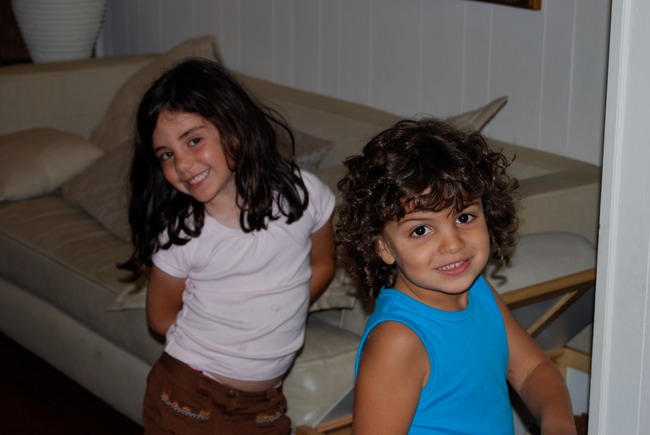
my lovely nephew jude and his cousin lauren.
Tomorrow (ghadan)
hi good people,
whether or not the university is ope tomorrow, you should have completed C7 Readings below, all 4 chapters. this is one of the foundations of this course, and will certainly be prominent in the final exam.
make sure you read both chapters from Richards and Waterbury (not just one).
see you tomorrow barring another closing....
be safe. don't do anything i wouldn't do.
b
(c7) The Political Economy of Development and Oil: Social Impact
A. The political economy of development
B. State-Led Development
C. The political economy of oil
Readings:
1. Elias H. Tuma, Chapter 7, “The Economies of the Middle East,” in Deborah J. Gerner and Jillian Schwedler, eds., Understanding the Contemporary Middle East (Boulder: Lynne Rienner, 2004), pp. 234-End. [Text]
2. Alan Richards and John Waterbury, Chapter 7, “The Emergence of the Public Sector,” Chapter 8, “Contradictions of State-Led Growth,” in A Political Economy of the Middle East (Boulder: Westview Press, 1996). [CW]
3. Michael Ross, “Does Oil Hinder Democracy,” in World Politics 53. 3 April, 2001. [CW]
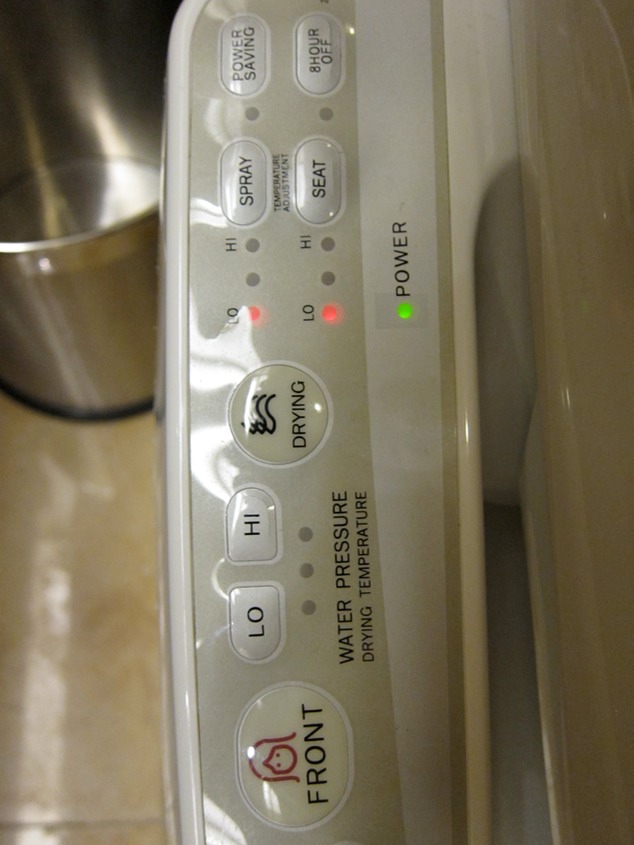
This toilet seat comes standard in all bathrooms at the hotel i stayed in, in South Korea. Yes, it sprays cologne after.
Grading Criteria
GRADING CRITERIA
POP QUESTIONS (PQ’S)
Pop questions at the beginning of class are worth two points. These are usually straightforward questions for which there is little room for interpretation. I offer partial credit when deserved.
REFLECTION PAPERS
Reflection papers are
worth two points. They are written after watching a film/documentary in class,
or after attending an event on campus that is related to the course. In case of
films/documentaries, the reflection paper must be written after the video is complete
(in case we watch in two parts) unless otherwise instructed. These one pagers
should engage the video or event in ways that relate them to class material.
For more information, see Reflection Paper Guidelines.
RESPONSE PAPERS
Response papers are assigned by the instructor, and are worth 10 points unless otherwise stated. Response papers should be more analytical than descriptive and demonstrate a deep engagement with the subject matter. Usually, they constitute a response to an article or a set of articles assigned. They should be 3-5 double-spaced pages and should adhere fully to the Response Paper Guidelines.
EXAM SECTION
Exam Letter and Numerical Grades
Short answer or ID questions are presented as numerical grades on your exam.
Essay questions and ID questions are combined to produce a total exam grade. Usually, there will not be an independent grade for the Essay as this will be reflected in the final grade. This allows the instructor to give the student the benefit of the doubt when deserved, and to apply a curve for the whole class when necessary. I offer letter grades as such:
1. Solid letter grades: A, B, C, D, F, with or without "plus" or "minus" (e.g., B+, C-)
2. Composite letter grades: A-/B+, B+/B, etc. (this means you are border line between the two grades).
Essay Evaluation Criteria
Essays constitute the culmination of your learning experience in the course. The are graded on the following criteria:
1. Clear and comprehensive answers to the component parts of the Essay question.
2. Exhibit Strong familiarity with the readings and lecture.
3. Citing authors and articles as the argument is presented.
4. Quality of writing.
· To receive an A-range grade, all four components should be satisfied fully.
· To receive a B-range grade, three components have to be satisfied fully, especially #1, and one component must be satisfied partially.
· Anything less runs the risk of a C or below. If you have a "See Me" on your Exam cover, you should, well, see me! This means i either want to give you an opportunity to ameliorate your grade, or that I have and important question.
Short Terms, Concepts, and ID Evaluation Criteria
All shorter answers must be presented comprehensively to satisfy the question. All answers must include a separate note below the answer that states the significance of the term(s) in question. Thus, students should provide the answer/definition, and proceed to indicate its significance (i.e.,, why is it important, what else does it help us understand, how is it related to the literature and course materials/lectures, etc.). There usually is more than just one significance for every question.
GRADE RE-EVALUATION POLICY
All grades can be disputed. However, disputes involve re-grading, which might increase or reduce the grade in question.
IMPORTANT NOTES
I grade progressively: this means if you do better on the final exam, and your midterm grade is above C, your midterm grade will be discarded and the final exam grade will be privileded. To protect students, the reverse is not true (i.e., if you do worse on th final, that grade will not be privileged).
Reading for Monday
hi all,
hope you had a good weekend. For Tuesday, please do C6 reading. After you complete the Crystal reading from C5 (which shoudl have been completed before the midterm), I would like you to start with Taraki and Tucker from C6 then make your way towards teh rest (the pieces are mostly short).
see you soon.
bassam
(c5) Politics, the State, and Authoritarian Rule (2 Sessions)
- Jill Crystal, “Authoritarianism and its Adversaries in the Arab World,” in World Politics, 46 (January 1994), pp. 262-289. [CW]
Questions & Issues to Consider: Is authoritarian rule unique to the Middle East? What produces authoritarian rule? What sustains it? How does authoritarian rule affect state-opposition dynamics? Is there a relationship between levels/kinds of authoritarianism and extremist opposition? What are the bases of conflict in the Middle East?
(c6) Social Dynamics: Family and Women, Community, Ethnicity and Class
Readings:
- Lisa Taraki, Chapter 11, “The Role of Women,” in Deborah J. Gerner and Jillian Schwedler, eds., Understanding the Contemporary Middle East (Boulder: Lynne Rienner, 2004). [Text]
- Judith Tucker, ed., Arab Women: Old Boundaries, New Frontiers, Ch. X, "The Arab Family in History," pp. 195-207. [CW]
- Lila Abu-Lughod, “Do Muslim Women Really Need Saving? Anthropological Reflections on Cultural Relativism and Its Others,” American Anthropologist, Sep. 2002; 104, 3. [CW]
- Maya Mikdashi, "How Not to Study Gender in the Middle East," Jadaliyya, March 2012. [CW]
Questions & Issues to Consider: What is the relationship between societal development and the role of the family? What is the relationship between the role of the family in the society and gender roles? What are the bases of political action in the Middle East (e.g., communal, sectarian, religious, class, political, economic, cultural)? In studying the Middle East, why does the question of the “veil” become an all-too-important issue when other issues are clearly more significant? Should we take liberal discourse on feminism at face value (e.g., “we invaded Afghanistan partly to liberate their women”)?
Bring Blue Books Today!
hi everyone,
I've announced this in class and during the study session, but please remember to bring bluebooks with you today.
see you soon. don't worry about the exam. it is such a small spec of dust in comparison to the Universse.
b
Midterm Study Session
hi everyone,
this is a reminder that we will have a study session tomorrow at 7:30. the meeting location will be at Robinson A 227.
see you all there. please bring not only your questions, but your notes as well.
bassam